
4 Ways Site Documentation Saves You Time and Money on Your Buildout
What is Site Documentation?
Site Documentation is a process. We work with you to document your potential site before you sign your lease.
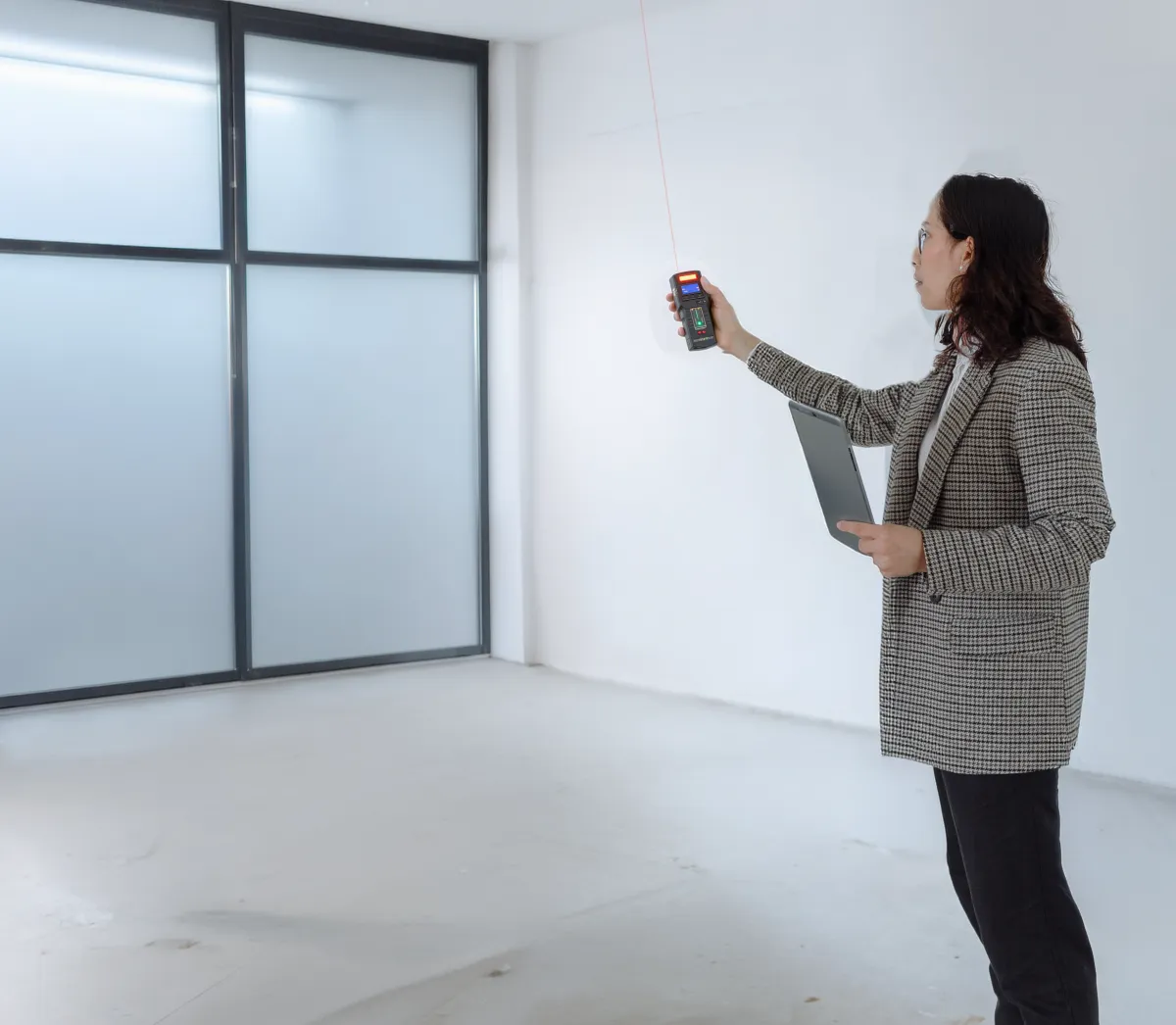
Your project manager will video call you remotely while you're on-site at your potential location. Together, you'll walk through the space, measuring the dimensions with a laser measuring tool, photographing the space and utilities.
Then your project manager then creates your Site Documentation report. This report includes your dimensioned floor plan and your full utility and equipment details, like HVAC and electrical systems. Once your report is completed, it's ready to hand off to your architect for your test-fit.
A test-fit is a 2 dimensional preliminary layout drawing that shows how a franchise's standard equipment, fixtures, and furniture could fit into a specific space, based on a floor plan.
Site Documentation is not an industry standard step in the buildout process.
Most people skip this step and go straight to a test-fit. But if you start that layout with inaccurate or missing information, it's as good as a shot in the dark.
A Site Documentation report gathers that missing information so you can move into your test-fit and lease negotiations with a more complete picture. We've seen this save clients thousands of dollars.
Here are 4 of the most common things a Site Documentation catches:
01 An Incorrect Floor Plan
A test-fit works off whatever floor plan you're given, it doesn't verify that plan is accurate. Often, we see floor plans off by a couple of feet. It may be inaccurate because it's an old floor plan that doesn't reflect a previous tenant's changes or because the floor plan was made with estimates instead of accurate measurements.
Designing your space off an inaccurate floor plan can cost you.
We had a client who planned on putting in three bays of golf simulators. The floor plan he was given said he had the room for it, but after a Site Documentation report, it was revealed the floor plan was wrong, and he didn't have the space needed, at least not with his original design. With some creative thinking, we were able to fit three bays in a different configuration. But if that hadn't worked, he still could have changed locations, since he hadn't signed a lease yet.
If he hadn't discovered that until after he'd hired a contractor, it would've cost him to: redesign the plans, remove/ reinstall anything already in place, and pay the contractor change orders.
02 Low Ceiling Height
A test-fit is only a 2 dimensional layout, it doesn't check ceiling height. If your FDD has a ceiling height requirement and you don't account for that until after you sign your lease, that can cost you.
We've seen this happen to clients a number of times. Sometimes something can be done in the plans to make it work, other times they needed to find a new site.
03 An Outdated HVAC System
HVAC systems are rated until a certain date. Once that date passes, they need to be replaced.
If you sign on a space with an outdated HVAC system, it's your responsibility to replace it in order to operate your business. But if you know its outdated before you sign your lease, you can negotiate the HVAC replacement into your terms, or decide to find a new site.
04 Not Enough Electrical Capacity
Potential power to your unit is unlimited but actual capacity is dependent upon the equipment installed. Power is limited by both your unit's electrical box and the building's overall electrical capacity.
When your electrical box is maxed out, you can upgrade the equipment to increase capacity, but only as much as the building's electrical system allows. If you need more power than your unit is allowed, means the building's electrical system itself has to be upgraded.
Signing a lease without knowing your electrical capacity puts those upgrade costs on you, or worse, leaves you stuck with a site that simply won't work.
Knowing about these limitations ahead of time means you can negotiate unit or building upgrades into your lease, or decide to find a different site that better fits your needs.
The Bottom Line
Even just these four reasons make it clear why Site Documentation is so important before you sign your lease.
If you have questions or want to work with Realm to create a Site Documentation report for your site, be sure to schedule a quick call with us. We'd love to help!



